


The Shop Manager's Guide to Industrial Dust Collector Maintenance
Maintaining an industrial dust collection system is a technical requirement for ensuring operational efficiency and regulatory compliance. Whether managing a large-scale manufacturing facility or a specialized production shop, the performance of air pollution control equipment directly impacts employee safety and equipment longevity. This guide outlines the necessary technical procedures for maintaining industrial dust collectors, focusing on filtration efficiency, mechanical integrity, and adherence to OSHA and NFPA standards.
Technical Foundation of Dust Collection Maintenance
An industrial dust collector, such as the DustHog VB-1500 Downdraft Filtration Unit, operates on precise pneumatic and mechanical principles. Maintenance should not be viewed as a reactionary fix but as a structured protocol designed to manage pressure drops and capture velocities. Failure to maintain these systems results in "process air" contamination, where particulate matter remains suspended in the breathing zone, potentially violating OSHA indoor air quality standards.
Understanding Differential Pressure
The most critical metric for any shop manager is differential pressure. Measured via a Magnehelic gauge or a digital transducer, this value indicates the resistance of the filter media. A baseline "clean" pressure is established when new dust collector filters are installed.
As the dust cake builds, the pressure rises. If the differential pressure exceeds the manufacturer's specified limit: typically between 4 to 6 inches of water gauge (w.g.): airflow volume decreases, leading to poor capture at the source. Conversely, a sudden drop in pressure often signifies a "blowout" or a torn filter, allowing hazardous particles to bypass the filtration stage entirely.
Daily Inspection Protocols
Daily checks are the first line of defense against system failure. These tasks should be performed at the start of every shift and documented in a maintenance log.
- Monitor Differential Pressure: Record the gauge reading. Consistent tracking allows managers to predict filter life and schedule change-outs before an emergency shutdown occurs.
- Compressed Air Pressure Verification: For pulse-jet systems, ensure the compressed air header is maintained at the correct setpoint, usually 90–100 psi. If the pressure is too low, the cleaning pulse will be insufficient to dislodge the dust cake.
- Hopper Discharge Check: Industrial dust collectors are not storage units. Hoppers must be emptied daily to prevent "bridging," where dust packs into a solid mass. Bridged dust can lead to fire hazards or structural damage due to excessive weight.
- Visual Emission Audit: Inspect the exhaust stack or the clean-air return. Visible dust indicates a leak in the filter seals or a failure in the media.
Weekly Preventive Maintenance
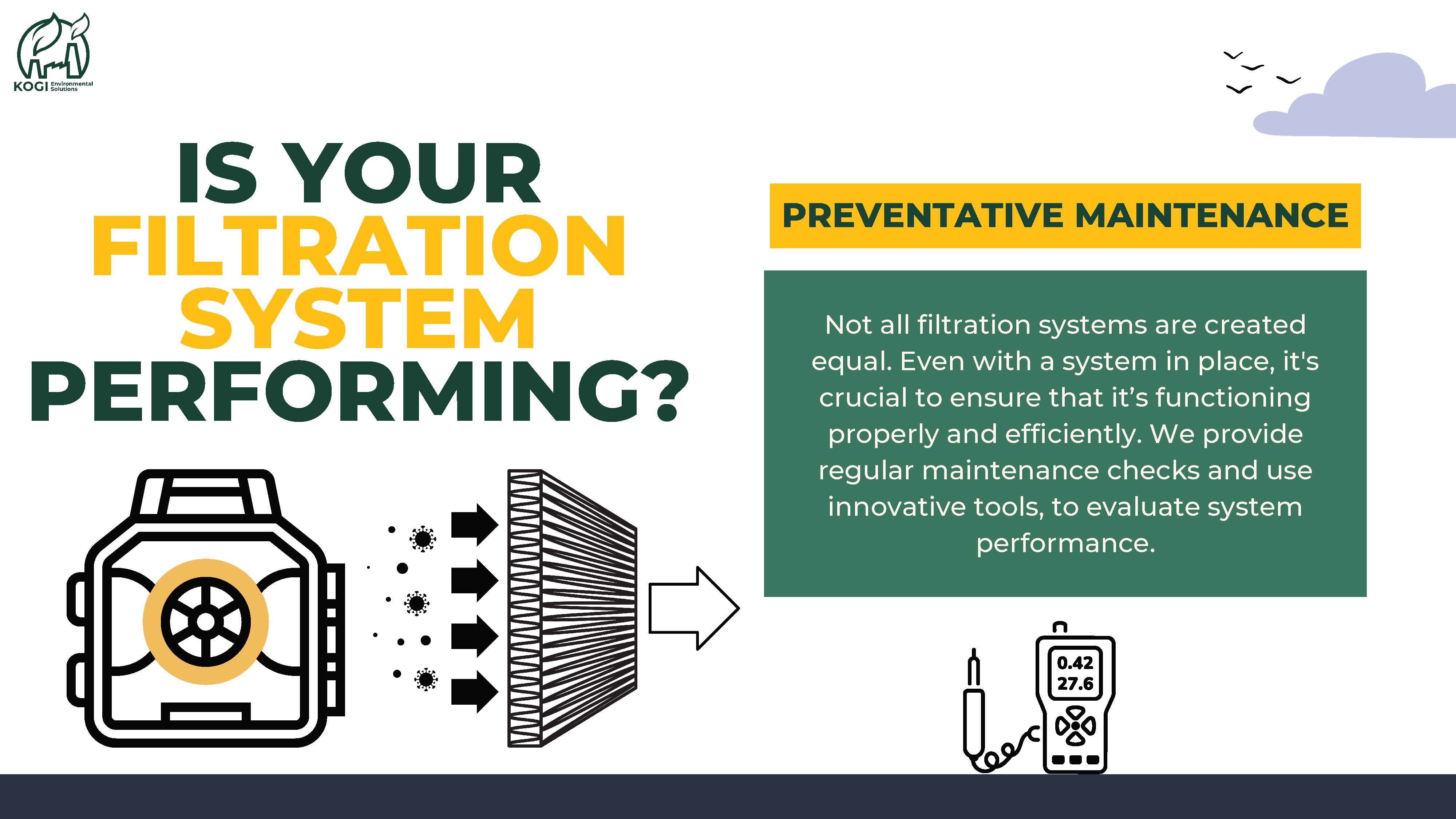
Weekly tasks focus on the mechanical components that drive the filtration process. Mechanical failure in the fan or cleaning system can render a high-capacity collector like the VF-1500 Fixed Portable Dust Collector ineffective.
Pulse-Jet System & Valves
Inspect the diaphragm and solenoid valves. Listen for the distinct "thump" of each pulse. A weak or missing pulse indicates a failed solenoid or a ruptured diaphragm. Continuous leaking of air (a "hissing" sound) suggests a valve stuck in the open position, which wastes compressed air and reduces cleaning effectiveness for the entire manifold.
Fan & Motor Assembly
The fan is the heart of the air movement system. Check the fan belts for proper tension and alignment. Excessive vibration often points to dust buildup on the fan blades, which causes imbalance. Using fan balancing services can mitigate long-term damage to bearings and motors.

Quarterly Structural & Media Audits
Every quarter, a more invasive inspection of the internal components is required. This ensures the structural integrity of the housing and the performance of the filter seals.
Filter Media Inspection
Not all filters are equal. Systems utilizing BHA PulsePleat® Dust Collector Filters or horizontal cartridge units require specific handling. Remove a sample filter and check for:
- Blinding: A permanent layer of dust that cannot be pulsed off.
- Abrasion: Holes caused by high-velocity dust particles striking the media.
- Moisture Damage: "Mudding" of the filter media due to oil or water in the compressed air lines. If moisture is present, inspect the air compressors and dryers for proper condensate removal.
Gaskets & Seals
Check the door gaskets and filter seating surfaces. In systems like the VB-750 Downdraft Bench, even a small air leak around the access door can cause a significant loss in suction at the work surface. Ensure all fasteners are tight and gaskets remain pliable.

Combustible Dust & Compliance: NFPA 660 & OSHA
Shop managers must navigate a complex regulatory landscape. OSHA enforces standards regarding indoor air quality and hazardous dust levels, while the National Fire Protection Association (NFPA) provides the technical standards for fire and explosion prevention.
NFPA 660 Consolidation
The new NFPA 660 standard consolidates various combustible dust codes. It requires facilities to conduct a Dust Hazard Analysis (DHA) every five years. Maintenance logs play a critical role in this analysis. If a collector handles combustible materials (wood, metals, organic chemicals), ensuring that explosion vents are unobstructed and isolation valves are functional is a mandatory maintenance task.
OSHA Permissible Exposure Limits (PEL)
OSHA monitors the concentration of particulate matter in the air. If maintenance is neglected and the collector's capture velocity drops, the facility may exceed PEL for specific dusts. Regular air quality monitoring is recommended to verify that the dust collection system is performing according to its design specifications.

Optimizing Airflow: Ductwork & Installation
Maintenance extends beyond the collector itself to the entire industrial ducting network. Dust accumulation in the ducts, known as "drop-out," occurs if the transport velocity falls below a critical threshold (typically 3,500 to 4,500 feet per minute for industrial dust).
- Duct Cleaning: Periodically inspect duct runs, especially elbows and horizontal sections, for dust buildup. Accumulated dust increases resistance and creates a significant fuel load for potential fires.
- System Balancing: If new machines are added to a production line, the duct system must be re-balanced. An improperly balanced system may provide excessive suction to one station while leaving another with inadequate airflow.
Maintenance Checklist Summary
| Frequency | Component | Action |
|---|---|---|
| Daily | Magnehelic Gauge | Record differential pressure. |
| Daily | Hopper | Empty dust containers; check for bridging. |
| Weekly | Pulse Valves | Verify solenoids and diaphragms are cycling. |
| Weekly | Drive Belts | Check tension and alignment of the fan motor. |
| Monthly | Compressed Air | Check for oil/water in the air header. |
| Quarterly | Filter Media | Inspect for blinding, tears, or mudding. |
| Annual | Structure | Full inspection of welds, supports, and vents. |
Conclusion
Systematic maintenance of industrial dust collectors is essential for operational continuity and safety. By adhering to a rigorous schedule of inspections: ranging from daily pressure monitoring to quarterly media audits: shop managers can ensure their facilities remain compliant with OSHA and NFPA standards. Utilizing high-quality replacement parts, such as BHA filters and OEM-certified technicians, ensures that the air pollution control system operates at peak efficiency for its entire service life. For complex installations or system upgrades, professional customized design services should be consulted to maintain proper airflow and capture velocities across the production floor.