


The Shop Manager's Guide to OSHA-Compliant Welding Fume Extraction
OSHA Welding Fume Extraction: What “Compliant” Looks Like on the Floor
OSHA’s expectation is straightforward: control welding fumes and gases so worker exposure stays below applicable exposure limits. In practice, that means a documented ventilation strategy, verified capture performance at the arc, and a maintenance program that keeps the system performing the way it was designed.
For most fabrication and repair shops, the compliance path starts with local exhaust ventilation (LEV). LEV is the primary control method because it captures fume at the source instead of diluting it after it spreads through the bay.
Exposure Drivers: Process, Material, and Workstation Layout
Welding fume risk is not uniform across a shop. The exposure profile changes with:
- Process (MIG, TIG, FCAW, stick, plasma cutting, gouging)
- Base metal and filler (mild steel vs. stainless, hardfacing alloys, nickel alloys)
- Coatings and residues (galvanizing, paint, oils, solvents, primers)
- Arc time and duty cycle (high deposition work vs. intermittent tack welding)
- Distance to capture (hood/nozzle placement and welder positioning)
- Air movement patterns (makeup air, overhead doors, fans, cranes, process heat)
A frequent compliance failure isn’t “no equipment,” it’s capture that looks good on paper but misses the plume due to poor hood placement, cross-drafts, or loaded filters.
Local Exhaust Ventilation (LEV): Minimum Capture Velocity and Placement
OSHA guidance commonly cited by shops calls for ~100 feet per minute (fpm) air velocity in the welding zone for effective capture in typical scenarios. Whether you achieve that depends on hood geometry, distance from the arc, and system static pressure.
Shop-manager practicals for LEV placement:
- Keep the hood/nozzle as close as feasible to the fume source (capture falls off fast with distance).
- Position extraction so the fume plume is drawn away from the welder’s breathing zone.
- Keep exhaust discharge and airflow paths from pushing fume toward adjacent workers.
- Treat open doors, ceiling fans, and makeup air diffusers as “capture killers” unless balanced.
When LEV isn’t feasible: OSHA allows mechanical dilution ventilation in some cases, but dilution is typically a supplement: not a substitute: when high-hazard materials are involved or when consistent plume control is required.
Space and Volume: The “10,000 ft³ per Welder” Rule of Thumb
OSHA section 1910.252 is often interpreted in the field as requiring a minimum of 10,000 cubic feet per welder for “optimum” airflow in certain indoor scenarios. This is not a “buy this one box” requirement: it’s a planning constraint that affects:
- How many welders can operate simultaneously in a bay
- Whether partitions/curtains create stagnant pockets
- Whether general ventilation is meaningful or just moving smoke around
Ceiling height matters. Lower ceilings reduce the buffer volume and can force more aggressive LEV and/or engineered general ventilation. If your welding area has ceilings under ~16 feet, assume you’ll need more deliberate ventilation control than “crack a door.”
Material-Specific Hazards: Where Extraction Alone May Not Be Enough
Welding fume extraction is a core control, but certain materials push you into tighter limits and additional respiratory controls.
| Material / Condition | What changes | What to implement |
|---|---|---|
| Stainless steel | Hexavalent chromium exposure potential | Strong LEV, disciplined hood placement, housekeeping, exposure verification |
| Galvanized steel | Zinc oxide fume (metal fume fever risk) | LEV + pre-clean where possible; avoid welding through heavy coating |
| Beryllium-containing alloys | Very high toxicity | Supplied-air respiratory protection may be required; do not rely on ventilation alone |
| Lead, cadmium, mercury | High toxicity metals | Additional controls; in some cases airline respirators; strict hazard communication |
| Paints/solvents/residues | Decomposition products add unknowns | Surface prep and LEV; confirm coatings before hot work |
Surface prep is an extraction strategy. Removing coatings and solvent residues reduces the contaminant load your welding fume extractor has to capture and keeps filters from loading with sticky or reactive particulate.
Confined Spaces: Ventilation and Respiratory Protection Rules Tighten Fast
If welding occurs in tanks, vessels, pits, or other confined areas, treat the job as a confined space problem first and a welding problem second.
Operationally, confined welding requires:
- Ventilation designed for that space (not “shop air”)
- Continuous awareness of fume migration and oxygen displacement risk
- Respiratory protection escalation where required (especially for lead, cadmium, beryllium, mercury)
If a job plan depends on “we’ll put a fan somewhere,” that’s not a control strategy: it’s a guess.
System Selection: Source Capture Options That Actually Work
There’s no single “best” fume control setup. Shops usually standardize on a few workstation types based on production mix.
1) Extraction Guns: High Capture at the Arc, Higher Maintenance
Extraction guns pull fume at or near the nozzle, which helps when parts are large, awkward, or constantly repositioned. They also add consumables and require airflow verification; low flow turns them into expensive standard guns.
Best for: repetitive MIG work, frequent repositioning, tight bays
Watch-outs: operator acceptance (weight/handling), hose damage, reduced performance as filters load
2) Capture Hoods and Flex Arms: Good Control with Good Discipline
Flexible arms can work well when operators consistently place the hood correctly. If they don’t, performance drops.
Best for: bench welding, fixtures, training booths
Watch-outs: cross-drafts, hood “too far away,” arms left parked behind the plume
3) Enclosures and Booths: Highest Consistency for Production Lines
If you can enclose the source, you get repeatable capture and less interference from airflow patterns.
Best for: production welding cells, robotic welding
Watch-outs: makeup air planning, access constraints, maintenance access for ducting and filters
4) Downdraft Benches: Also Useful for Grinding and Finishing
Many shops blend welding and post-weld finishing at the same station. A downdraft bench is often a practical way to control dust and particulate during grinding, sanding, and deburring (and to prevent that dust from becoming your “background” exposure).
For reference units typically used in mixed fabrication environments include downdraft-style collectors such as the Dusthog VB Series (example: https://www.kogi-es.com/es/products/dusthog-vb-1500-downdraft-filtration-unit-1500-cfm-industrial-dust-collector).
Electrostatic Precipitator (ESP) vs. Mechanical Filtration: Where Each Fits
Shops often mix contaminant types: welding fume, oil mist from machining, and general dust. The right technology depends on particle characteristics.
Electrostatic Precipitator: Strong on Smoke/Mist, Needs Cleaning Discipline
An electrostatic precipitator uses electrically charged collection stages rather than disposable media as the primary capture method. ESPs are commonly used for smoke and mist applications and can be effective when maintained correctly.
Typical shop manager considerations:
- Cleaning intervals and procedures must be defined and followed
- Performance can degrade quietly when cells are dirty
- Confirm suitability for the specific fume/mist type and loading rate
An example of an ESP-based unit is the Smog-Hog PCN Mobile Electrostatic Fume and Mist Collector:
https://www.kogi-es.com/es/products/smog-hog%C2%AE-pcn%C2%AE-mobile-electrostatic-fume-and-mist-collector
Cartridge/Media Collectors: Predictable Filtration, Filter Management Required
A cartridge-style industrial dust collector or dedicated welding fume collector relies on filter media and pulse cleaning (or staged filtration). It’s predictable and widely used, but compliance depends on:
- Correct air-to-cloth design
- Pulse performance (pressure, timing, dry compressed air)
- Filter condition, sealing, and changeout timing
Compressed Air Quality: Pulse-Cleaning Lives or Dies Here
If you operate cartridge collectors or other pulse-cleaned systems, your compressed air system becomes part of your air quality program. Wet or oily air causes:
- Media blinding
- Poor pulse performance
- Valve and diaphragm issues
- Faster filter loading and higher static pressure
A properly selected compressed air dryer is often the difference between “filters last months” and “filters last weeks,” especially in humid climates or where compressors cycle heavily.
Checklist for pulse systems:
- Verify pressure at the collector manifold under load (not just at the compressor)
- Confirm dryer performance and drain function
- Track differential pressure (DP) trends weekly
- Investigate sudden DP increases immediately (leaks, plugged filters, failed pulsing)
Dust Collector Filters: The Compliance Detail Shops Miss
In most real shops, compliance problems show up as maintenance problems first:
- DP creeping up over weeks
- Visible haze during high arc time
- Settled dust on horizontal surfaces
- Odor complaints or irritation symptoms
- Operators turning systems off because “it’s not doing anything”
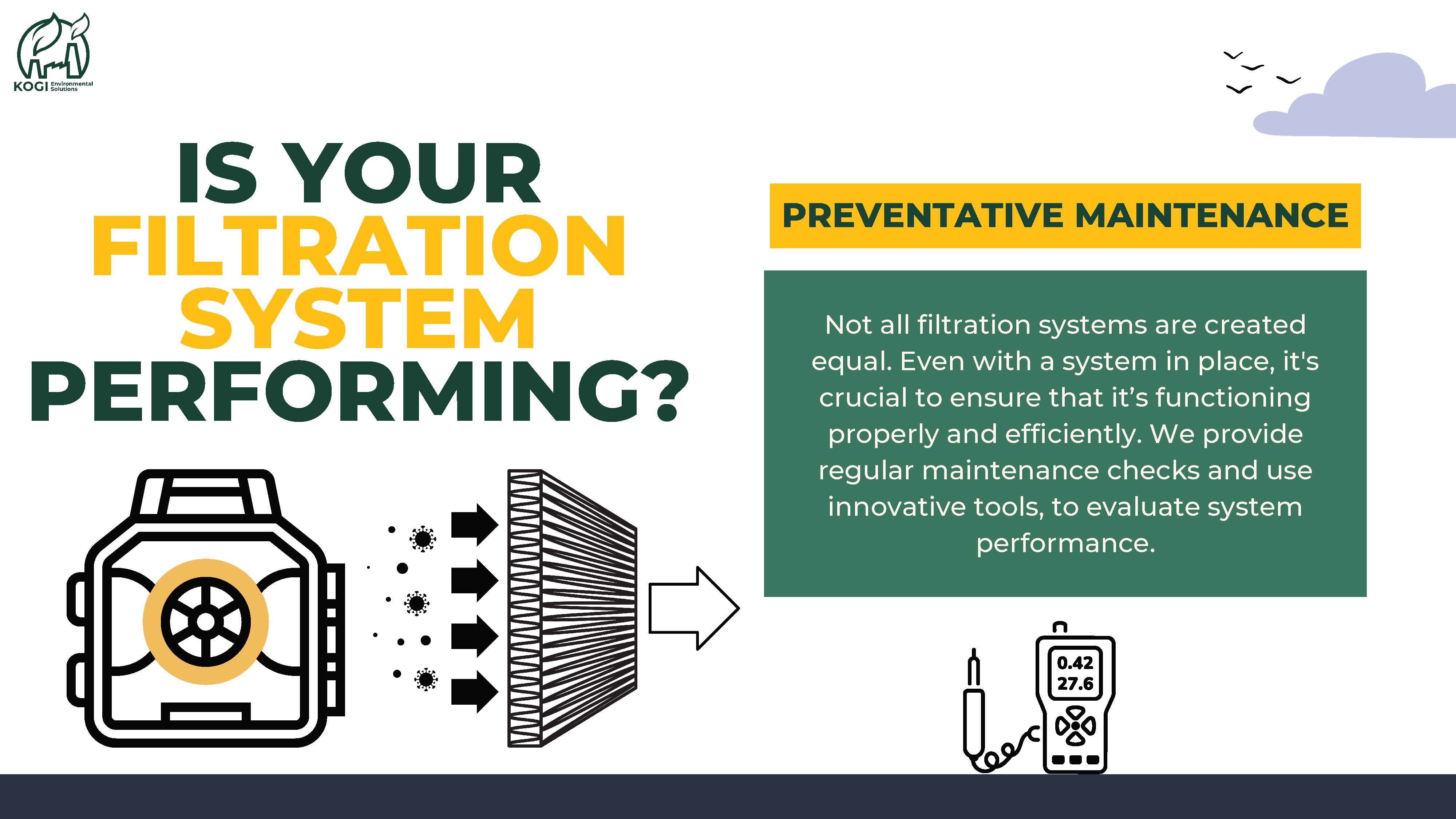
Your dust collector filters are a wear item and a control measure. Treat them like a calibrated tool, not a consumable you replace “when it looks bad.”
Filter program essentials:
- Record filter model/part numbers and media type
- Standardize changeout criteria (DP threshold + visual inspection + capture performance)
- Inspect door gaskets and tube sheets for bypass leaks
- Confirm proper seating and clamp torque
- Keep spares on-hand to avoid “run it another month” decisions
If your facility uses replacement filters for air cleaning equipment in other areas, keep purchasing and labeling consistent. Example replacement filter listing format:
https://www.kogi-es.com/es/products/z-line-400-hw-series-merv-11-glasfloss-z-series-air-cleaner-replacement-filters
Verification: How to Know Your Welding Fume Extraction Is Working
“Fan is running” is not verification. A simple, repeatable verification routine keeps your system defensible.
What to measure or confirm:
- Capture effectiveness at the arc (smoke tube checks, visual plume capture)
- Airflow at key pickup points (hood face velocity where applicable)
- Static pressure / differential pressure across filters (trend over time)
- Makeup air balance (negative pressure can starve hoods; positive pressure can push fume across the bay)
- Worker positioning (plume should move away from breathing zone)
Documentation to keep:
- System layout with hood locations and intended processes
- Maintenance logs (filters, ESP cell cleaning, fan belts, bearings)
- DP/pressure logs and corrective actions
- Training records (hazard communication and equipment use)

Shop Manager Takeaways: What Moves the Needle on Compliance
- Prioritize local exhaust ventilation and keep capture points close to the arc.
- Use 100 fpm in the welding zone as a practical benchmark for capture performance, then verify it.
- Treat filter management and compressed air quality as core compliance controls.
- Escalate controls for stainless and toxic metals; ventilation may not be sufficient for certain materials.
- Document airflow/DP trends, maintenance, and training so performance is repeatable: not dependent on one operator doing it “the right way.”